IBA DU - How I Finished WordSmart 1 in Seven Days; Apoplexy Week
December 2020. I was preparing for BUET, had not touched IBA prep, and a friend and I gave ourselves a week to finish Word Smart. Here is what happened.

The short answer
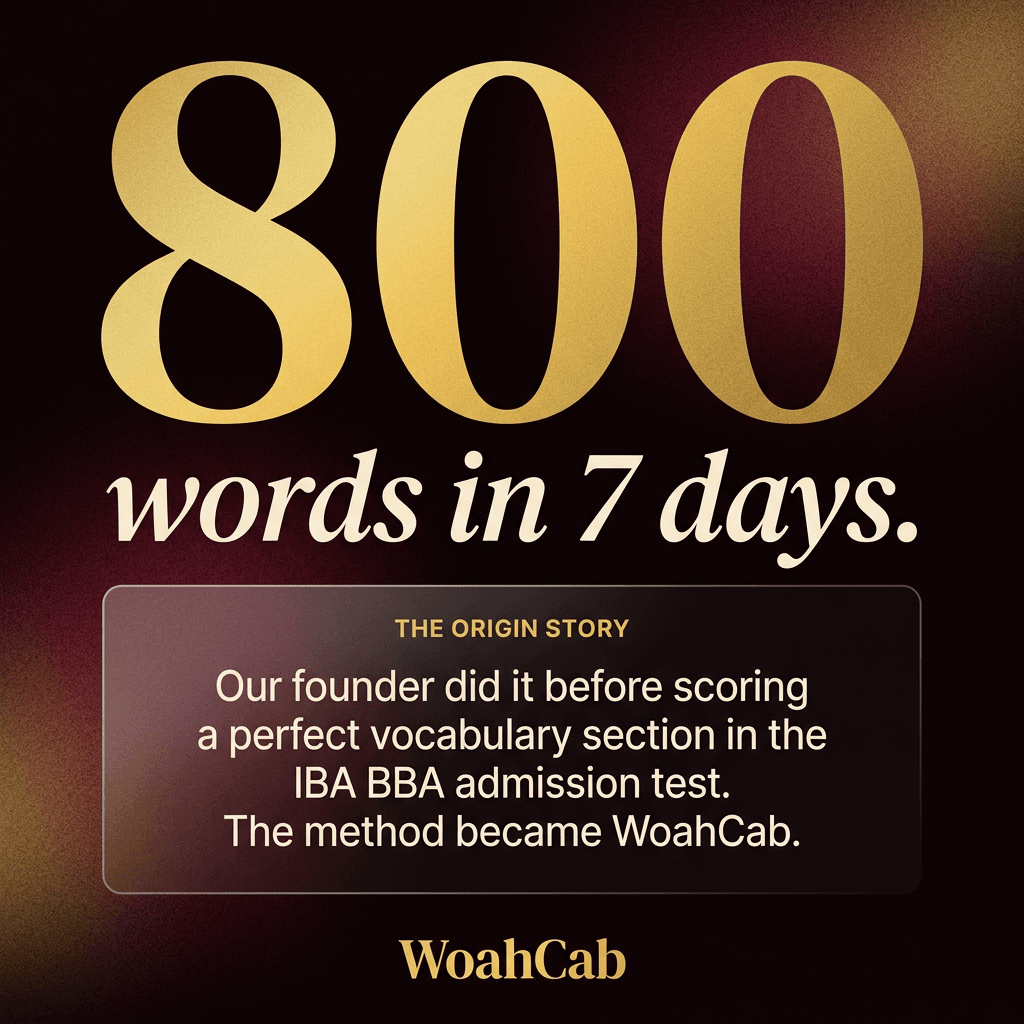
At 3am on 25 December 2020, a friend and I decided to finish all of Word Smart 1 before the new year. Seven days. We called it Apoplexy Week, after a word in the book. I finished at 7pm on 31 December, and I went on to rank 2nd in the IBA BBA 29th batch.
Three things made it work: reviewing on a schedule instead of by feel, building mnemonics only for the words that kept beating me, and cross-matching synonyms and antonyms in clusters instead of working alphabetically.
Where I was in December 2020
Depressed, mostly.
COVID had flattened everything. Classes were gone, the admission calendar kept moving, and nobody could tell me when anything would actually happen. The question I could not answer was the basic one. Where was I going? What was I going to study?
I had picked a lane by default rather than by decision. I was preparing for BUET, with the exam scheduled for January 2021. Every hour went to maths and physics, because that was the only plan I had.
Then December arrived and I did the arithmetic I had been avoiding. If BUET did not work out, I had a second option, and I had done nothing for it. Not a little. Nothing. IBA's paper is built around English and analytical ability, and I had not opened a word list.
That is a particular kind of panic. Being behind is one thing. Discovering you have been busy in the wrong direction is worse.
The 3am decision
On 25 December, at 3am, a friend and I made a deal. We would finish Word Smart 1, the whole thing, roughly 800 words, before the new year.
Seven days. We named it Apoplexy Week, which tells you what we thought our odds were. Apoplexy is in the book. It means a fit of rage, or a stroke.
The name did more work than a name should. It turned an open-ended dread into a project with a start date and an end date. Instead of "I need to learn vocabulary at some point," there was a thing with a deadline attached, and the deadline was six days after the deal.
We went day and night. Not a figure of speech.
What happened to my friend
He did not finish.
I am including that because the version of this story where two friends push each other across the line and both make it is a nicer story and it is not the one that happened. He started with me at 3am and he stopped somewhere in the middle of the week.
What having him there did was get me to start. Someone else saying yes at 3am converted a bad idea into a plan. What it did not do was carry me through day five, because by then I was on my own.
He is doing fine, incidentally. He went to Hungary on the Stipendium Hungaricum scholarship and finished his bachelor's there. Not finishing a word list in one week did not appear to cost him much.
If you are looking for the lesson: a partner is good for starting and unreliable for finishing. Build something that keeps you going after your partner drops out, because they might.
What I would not do again
I want to be careful here, because this post gets shared as though seven days is the recommendation. It is not.
Seven days worked because I had nothing else on, I was nineteen, and I was frightened enough to spend every waking hour on it. It cost me a week of sleep and it was unpleasant throughout. If you have two months, take the two months. The same three rules at 25 words a day get you to the same place with better retention, because longer gaps suit longer runways.
Keep the structure. Drop the compression.
The three rules
Reviewing on a schedule, not by feel
This is the one that did the actual work.
In the first stretch I was doing what everyone does, reading words and moving forward. Moving forward feels productive while the words behind you quietly fall out.
So I fixed return trips. A word learned in the morning came back that night, then two days later, then again. Every word had a scheduled reappearance rather than a vague intention to revisit it sometime.
The effect showed up fast. Same hours, spread differently, and words started staying.
There is a proper explanation for why this works, which I did not know at the time and only read about later. Memory drops sharply in the first day and keeps sliding for weeks unless something interrupts it, and spreading study across sessions beats packing it together at identical total time. I have written that up separately in why you forget IBA vocabulary three days after learning it.
I ran mine on paper. Piles, sorted by when each word was next due. It held for a week. It would not have held for three months, and that turned out to be the most useful thing I learned all week.
Mnemonics only for the words that kept beating me
I did not build a memory hook for all 800 words. There was no time, and most words did not need one.
I built them for repeat offenders. A word that failed me twice got a hook. Everything else went straight to sentence practice.
The hooks had to come from things I had actually seen, because those retrieve fastest. Banal became banning all the tired phrases. Truculent became a truck driver leaning out to shout somebody down. Nothing clever, nothing borrowed from an American word list where the reference lands on nobody here.
The method is written up properly in the three-part mnemonic formula, including why a hook that captures the sound but not the meaning leaves you remembering a picture and losing the word.
Cross-matching synonyms and antonyms
Word Smart is alphabetical. Alphabetical order is good for looking a word up and useless for learning one.
So I regrouped. Frugal, thrifty, parsimonious and miserly went into one group, ordered from approving to insulting. Their opposites went into a facing group. Learning them together taught me the ladder between them.
That mattered more than I expected, because the ladder is what the exam actually tests. IBA builds its wrong answers out of near-synonyms. Learn frugal in one week and parsimonious three weeks later and you have two unrelated facts and a coin flip. Learn them as a line and half the options fall away before you finish reading them. The full approach is in learning words in clusters.
7pm, 31 December 2020
I finished at seven in the evening on the last day of the year, with hours to spare on a deadline I had set at 3am while fairly convinced it was not possible.
Then something less useful happened. Finishing that fast made me overconfident, and the overconfidence lasted a while. When you clear something everyone told you was impossible, the obvious conclusion is that the other hard things are also easier than advertised. That conclusion is wrong, and the rest of my admission journey is a longer story for another post.
What the week actually did was narrow. It removed the section that had been quietly costing me marks, and it removed it before I had properly started IBA preparation at all. I went into the rest of my prep with English handled rather than hanging over me.
I ranked 2nd in the IBA BBA 29th batch.
As for BUET, the January exam never happened in January. Lockdown pushed it, and pushed it again, and it finally took place in October 2021. That was 2020 and 2021 for everyone sitting admissions: a calendar that kept moving under you. It is one reason I stopped treating a single exam as the whole plan.
Why I built WoahCab
The origin is unglamorous. It is the paper piles.
The method worked. The system for running the method was five stacks of paper on a floor, and I knew while I was using it that it would collapse past a few hundred cards over any real timeline. Sorting cards is a tax you pay before studying, and it is why most people abandon the box in week four.
So the platform does the one thing paper cannot. It computes what is due today across 1,000 words and shows you that and nothing else. The SM-2 engine handles the scheduling, every word ships with the Bangla meaning and a mnemonic already built, and the 1,000 words sit in 40 thematic chunks rather than alphabetically, so the clustering is done before you start.
It is the thing I wanted at 3am on 25 December 2020. More about who built it and why is on the team page, and the same 1,000 words exist on paper in the book if you would rather work that way.
Should you copy this?
Partly. Here is what transfers regardless of your timeline.
| What I did | Copy it? | Why |
|---|---|---|
| Seven-day compression | No | Only worked because I had nothing else on and was frightened |
| Scheduled reviews | Yes | The rule that did the actual work, at any pace |
| Mnemonics for repeat failures only | Yes | Building 800 hooks wastes time you do not have |
| Meaning clusters over alphabet | Yes | Matches how the exam writes its wrong answers |
| Starting with a friend | Yes, for starting | Mine stopped mid-week. Good for momentum, unreliable for finishing |
| Testing with the book shut, daily | Yes | Recognition is not recall, and the exam tests recall |
If you are sitting the BBA paper, the full preparation guide is here. If you are sitting the MBA paper, here. If you have around two months, the 60-day plan is the unhurried version of what I did in a week, and it will serve you better.
Frequently asked questions
Can you really learn 800 words in a week?
I did, over seven days in December 2020, going day and night with nothing else scheduled. Getting 800 words into memory that fast is possible with constant spaced review. Holding them for months requires continued reviews at widening intervals, so a sprint gets you to the exam, not past it.
What book did you use?
Word Smart 1, roughly 800 words. I used it as the source list but regrouped the words by meaning rather than working through it alphabetically. There is a separate guide on how to use Word Smart for IBA, including how to triage it before you start.
How did you track your reviews?
Paper piles sorted by when each word was next due. It worked for one week and 800 words. It would not have worked over three months, which is the specific reason I later built the review engine into WoahCab.
How many new words a day is realistic for a normal timeline?
Twenty to thirty for most students studying 30 to 45 minutes a day. Past that, the next day's review queue grows faster than you can clear it, and skipped reviews remove the entire benefit. My rate only worked because I gave that week nothing else.
What rank did you get?
Second in the BBA 29th batch at the Institute of Business Administration, University of Dhaka.
Why is it called Apoplexy Week?
Apoplexy is a word in Word Smart, meaning a fit of rage or a stroke. It seemed like a fair description of what we were about to do to ourselves. Naming it turned an open-ended dread into a project with a start and an end, which helped more than it should have.
Start your own version
You almost certainly have more than seven days. Use them.
Take the diagnostic, find out how many of the 1,000 words you already own, and set a daily target you can hold for two months rather than one you can hold for a single heroic week. Two chunks are free, so you can test the method before deciding anything.
Tanvir Touhid Alvi
Tanvir mastered 800 words in 7 days using spaced repetition to secure top rank in IBA.